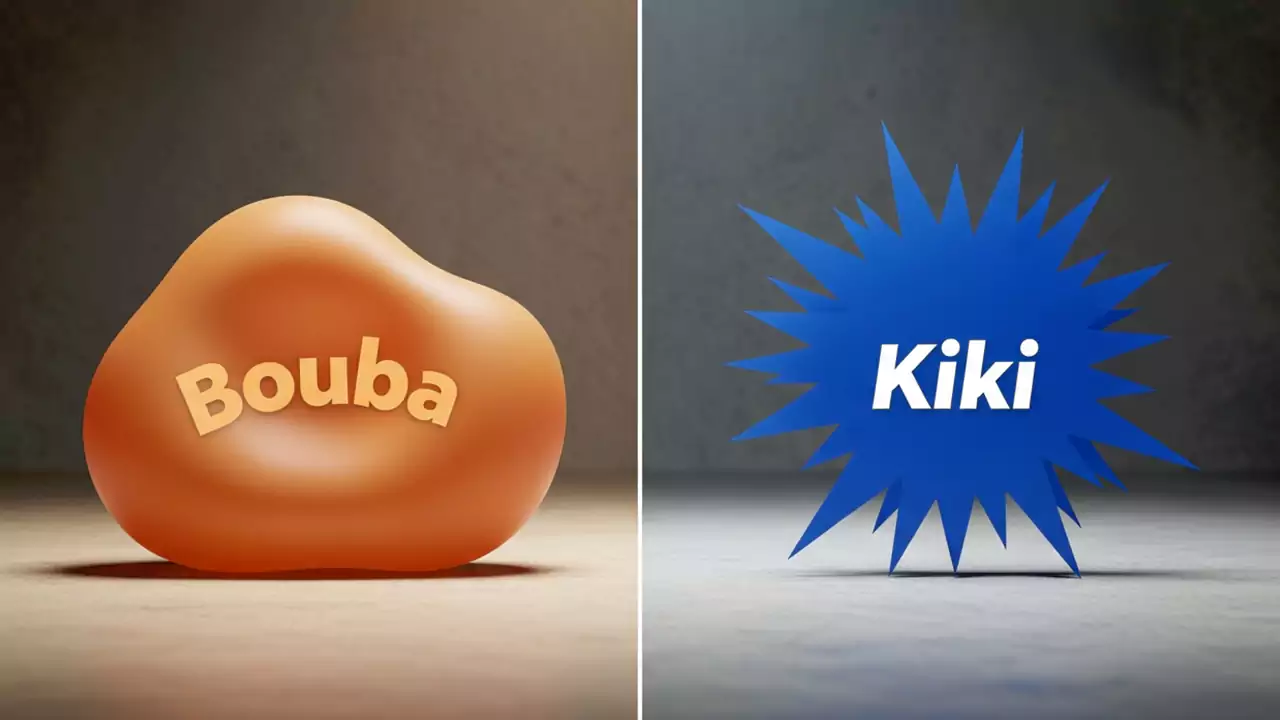
Imagine being asked to name two very different shapes, one round and soft like a cloud, the other sharp and angular like a star with spikes. Without conscious effort, most of us would give names that somehow feel right for each shape. This is what we call the Bouba-Kiki effect, a psychological phenomenon demonstrating that the human brain has a natural tendency to associate certain sounds with certain visual forms. This effect was first studied by psychologist Wolfgang Köhler in 1929 when he conducted experiments in Tenerife, Spain, asking participants to match nonsense words with abstract shapes. What makes the Bouba-Kiki effect particularly fascinating is its cross-cultural nature, where people from different parts of the world speaking different languages show remarkably similar patterns in connecting sounds with shapes, suggesting something fundamental about how our brains work that transcends cultural learning or individual experience.
Case Studies and Examples
In the classic experiment conducted by Vilayanur Ramachandran and Edward Hubbard in 2001, participants were shown two highly contrasting shapes. The first shape had rounded, curved, and smooth contours, while the second consisted of sharp angles and pointed protrusions. Participants were then asked to determine which one was called “bouba” and which was “kiki”. The results were striking and consistent, with approximately 95 to 98 percent of participants choosing the round, soft shape as “bouba” while the sharp, angular shape was selected as “kiki”. This pattern held true not only for English-speaking adults but was also found in three-year-old children and even in communities that had never been exposed to written language.
When we apply this effect to English words themselves, the same pattern emerges with remarkable clarity. Consider words that describe round, flowing, or soft objects and concepts, which typically use phonemes like /b/, /m/, /l/, /w/, /o/, and /u/. The word “balloon” serves as an excellent example, where the bilabial B sound using both lips and the rounded O and double O vowels feel perfectly matched to the inflated, spherical object. Similarly, “moon” describes a celestial body that is visually circular, and “bulge” conveys something that swells outward in a rounded manner. The word “lump” refers to a clump of matter with an irregular but generally rounded shape without sharp edges, while “mellow” uses soft consonants and low vowels to describe something smooth and gentle. Notice how “globe” with its soft G and rounded vowels naturally fits the spherical object it represents.
On the other side, we have words describing hard, sharp, broken, or small concepts that often employ stop consonants like /k/, /t/, /p/, and the vowel /i/. The word “crack” describes a sharp break or fissure, with the K sound creating a sudden stop that mirrors the abrupt nature of splitting. “Prickly” uses the sharp P, hard K, and high I vowel to convey something covered in sharp points. “Stick” refers to a long, thin, rigid object, and its phonetic composition with the hard consonants feels appropriately angular. The word “spike” directly means a sharp point, where the hard consonants K and P feel piercing and abrupt. “Tip” describes the pointed end of something, and even “shatter” with its harsh T sound effectively conveys the violent breaking of something into sharp fragments.
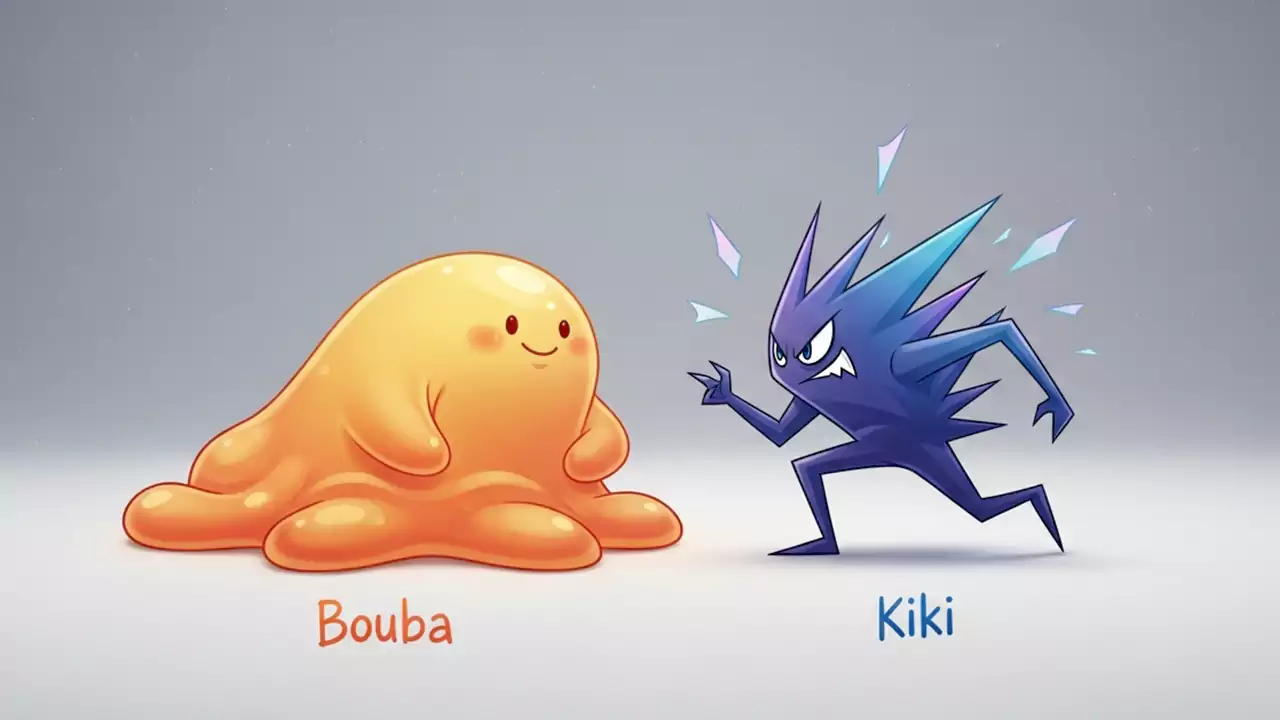
This pattern extends into commercial branding, though often unconsciously applied by marketers. Products aimed at conveying softness and luxury tend to adopt names with flowing sounds and rounded characteristics aligned with Bouba qualities. Meanwhile, products wanting to project speed, power, or energy often incorporate sharp consonants and angular characteristics that align with Kiki qualities, leveraging this deep cognitive connection between sound and perception to influence consumer impressions.
Discussion
To understand why the Bouba-Kiki effect occurs, we need to examine how the brain processes information from different senses simultaneously. The first mechanism at work involves articulation, or how we physically produce these sounds. When we say words like “balloon” or “bulge”, our lips form a rounded, soft shape, and air flows smoothly through the mouth without sharp interruptions. Imagine when you pronounce the U sound in “lump”, your lips will form a small circle that pushes forward, and this physical sensation actually mirrors the round shape you might be visualizing. In contrast, when pronouncing words like “crack” or “spike”, the tongue strikes the roof of the mouth sharply and quickly, creating a sudden stop of airflow when producing the K sound, generating a sensation that feels more angular and sharp. Beyond articulation, there is also a relationship between sound frequency and visual perception. Rounded vowels like O and U have lower frequencies and smoother sound waves, matching forms that flow without sudden changes. Meanwhile, plosive consonants like K or T produce sound waves with sharp frequency changes, similar to pointed angles in visual forms that create sudden directional shifts.
Neuroimaging research shows that brain areas processing visual and auditory information do not work in isolation but rather demonstrate what is called cross-modal correspondence. The superior temporal cortex, involved in sound processing, shows activity that correlates with visual areas when someone experiences the Bouba-Kiki effect. Think of the brain as an orchestra where various instruments must play harmoniously together, when you hear a soft sound while seeing a soft shape, different parts of your brain light up synchronously, creating an experience that feels right or fitting. There is also theory suggesting this effect may have evolutionary roots that provided adaptive advantages to our ancestors. The ability to connect sounds with shapes might have helped early humans survive, for instance recognizing that low, rumbling growls from tigers correspond to large, threatening body sizes, while high, sharp sounds might come from small, fast-moving animals. This sound-to-shape mapping enabled quicker responses to threats or opportunities in the context of hunting and gathering food.
The Bouba-Kiki effect provides important insights into how language develops, challenging the classical structural linguistics view that words are completely arbitrary. There is a possibility that word sounds have iconic or symbolic relationships with the meanings they represent, known as sound symbolism. In English itself, we can see this pattern in words like “whisper” where the sound mimics the soft, breathy quality of quiet speech, or “boom” whose sound reflects a deep, loud noise. The practical implications of understanding this effect extend widely into everyday life. In user interface design, buttons for quick or urgent actions might be more effective with angular shapes and sharp names, while features related to comfort can use rounded shapes with soft labels. In childhood language education, teachers can leverage children’s innate ability to recognize patterns between sounds and meanings by teaching words with iconic connections like onomatopoeia such as “meow” or “woof” first. In advertising and branding, products wanting to emphasize softness will be more effective with soft-sounding names and rounded logos, while products wanting to demonstrate strength can use hard consonants and angular forms, all of this being not manipulation but rather communication aligned with how consumer brains naturally process information.
Conclusion
The Bouba-Kiki effect opens a fascinating window into how the human mind works, showing that our brains do not process information from different senses separately but continuously seek patterns and coherence among all inputs received. The consistency of this effect across different cultures and languages proves this is a reflection of universal cognitive architecture rather than merely the result of social learning. Beyond being just a scientific curiosity, understanding this phenomenon has broad practical applications ranging from product design and branding to education and digital interfaces, helping us create more intuitive experiences that align with the natural way brains process information, and ultimately reminding us that there is still much to learn about the complex relationship between language, perception, and human cognition.