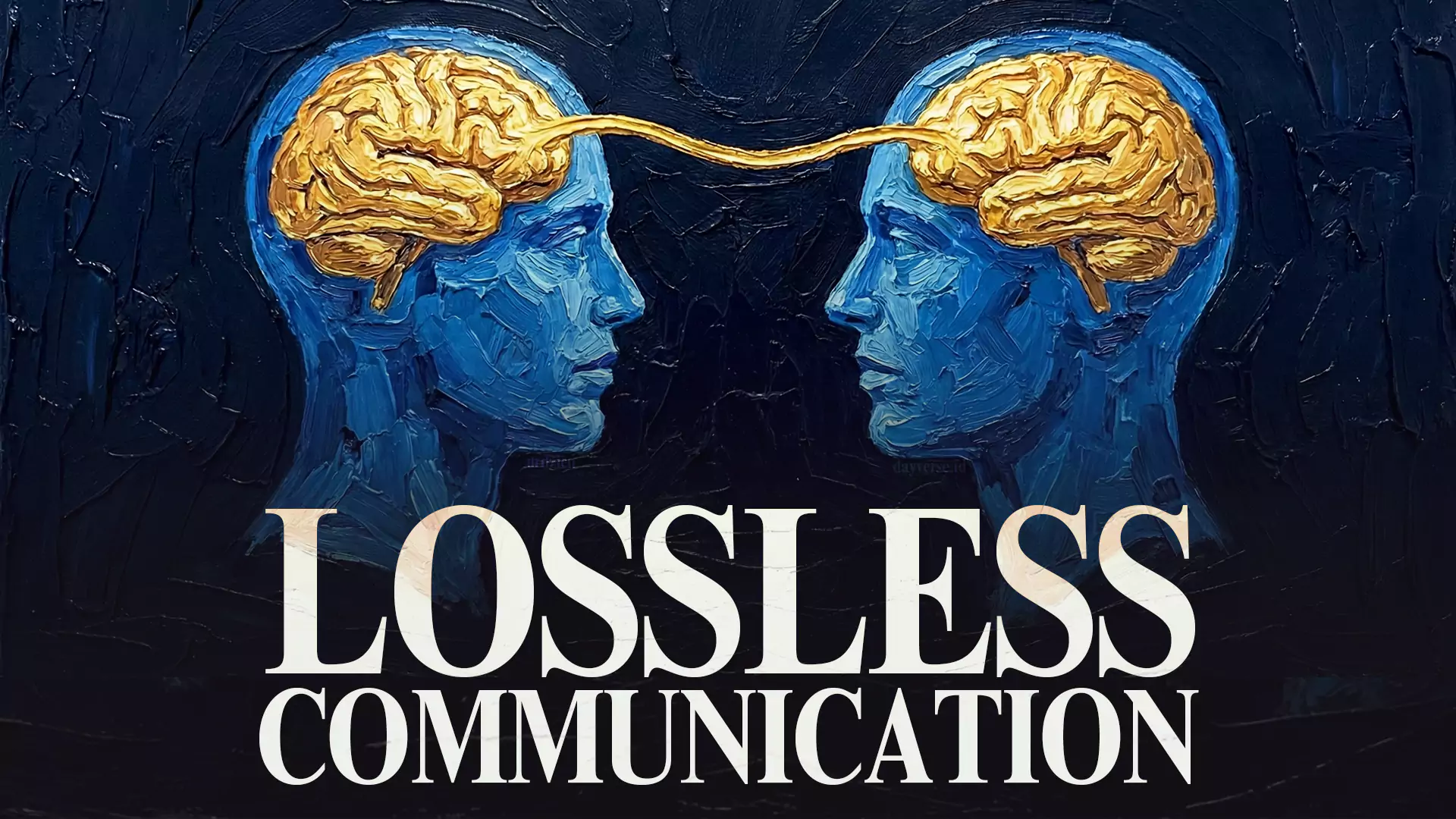
Many of us go through our daily lives holding onto a comforting belief that effective communication is the key to everything. We tend to believe that if we can choose the right words and construct sentences with proper structure, our conversation partners will understand our intentions completely and precisely. However, reality often shows something different because we frequently experience an odd loneliness precisely when we’re having deep conversations with someone. This paradoxical phenomenon raises a major question about the possibility of perfect communication, or what we might call Lossless Communication.
This term adapts a technical concept from the world of digital data, meaning the transmission of data without any information being lost or corrupted, similar to copying a file from one computer to another with one hundred percent accuracy. If this principle were applied to human interaction, the concept would demand that what exists in the sender’s mind could transfer completely to the receiver’s mind without the slightest distortion. This article will discuss in depth why this is technically, linguistically, and psychologically impossible for the human species to achieve.
Meaning Reduction Due to Language Limitations
The first and most fundamental barrier in human communication occurs at the stage of message encoding, or what is known as the encoding process. Feelings or ideas that live within someone’s mind have a very fluid and complex nature because they consist of layers of emotional nuance, abstract visual memories, and physical sensations that occur simultaneously within seconds. However, to convey this to the outside world, a person is forced to make a rather drastic and brutal simplification of their own inner experience.
We must compress a broad, high-resolution spectrum of feelings to fit into limited and rigid vocabulary boxes. Language is fundamentally just a general classification tool, so it often fails to precisely represent unique personal experiences. As a more in-depth illustration, consider when someone uses the word “pain” or “ache.” This word is a very dry generic label that cannot describe whether the pain is throbbing, stabbing, burning, or accompanied by paralyzing fear. The result is significant data leakage or data loss because we never truly convey what we feel, but only convey what can be represented by the limitations of the language we possess.
Interpretation Distortion Due to Background
If we assume the best-case scenario where someone can arrange words very precisely and poetically, that message still has the potential to suffer fatal damage when it arrives at the receiver’s side. This happens because every human listens to messages through a thick psychological filter formed from the accumulation of their past experiences. Messages never land in a neutral vacuum space but enter an inner landscape already filled with the receiver’s personal history and cognitive biases.
The environment where someone was raised and the culture that shaped them act like colored lenses that refract the meaning of incoming messages. A simple sentence or even silence intended as a form of comfort by the sender could be translated as a sign of anger or rejection by a receiver who has abandonment trauma in their past. This mechanism confirms that we do not see the world objectively; rather, we see the world based on who we are and what we have been through. The pure message from the sender will always mix with the subjective fears, suspicions, or hopes of the receiver, causing its original meaning to become distorted and change form.
Existential Isolation of Human Consciousness
The most fundamental and philosophical point of the impossibility of Lossless Communication lies in the biological fact that we are isolated within our individual consciousness. Every human is locked inside the “cinema” of their own mind and has no direct access to others’ sensory experiences. To this day, there is no technology or method that allows someone to see the color red exactly as another person’s eyes see it or feel grief exactly as another person’s nervous system feels it.
Every social interaction is fundamentally just an attempt to send signals, symbols, or sound codes from a distance across the chasm separating consciousnesses. We can try to guess, imagine, and empathize to approach that understanding, but we will never be able to perform a perfect soul experience transfer like copying digital data. There is always a part of ourselves that remains a mystery, unreachable and untranslatable by others, even by our closest partners or friends.
Conclusion
A deep understanding of the imperfect or lossy nature of communication is not something to regret or lament. On the contrary, this awareness is crucial so that we can have more realistic and forgiving expectations in relating to fellow humans. We need to realize that misunderstanding is a natural and inevitable part of human interaction due to the limitations of the communication tools we possess. By accepting this fact, we can become more patient and appreciate every awkward and simple attempt to understand each other, even though the result will never be perfect.