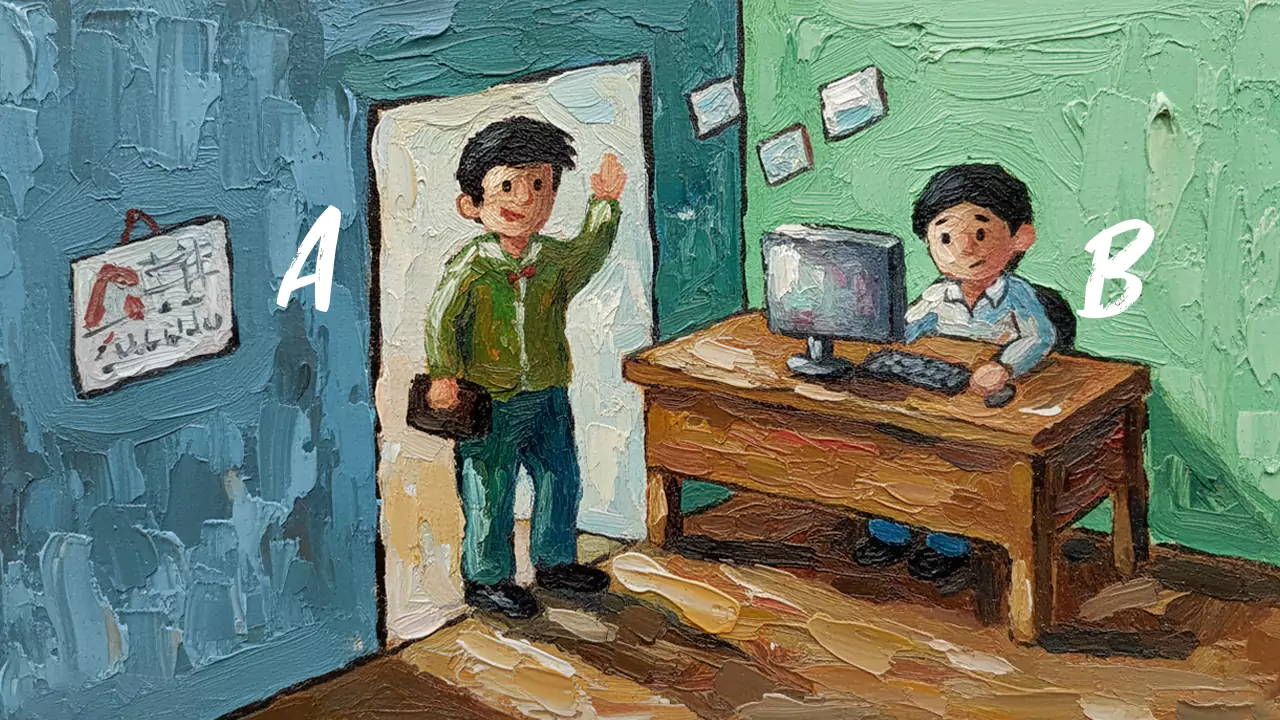
Imagine a morning ritual at the office that goes on for months. Person A greets Person B every day with a friendly tone. Person B never returns the greeting. At first glance, we might immediately make judgments about who cares and who doesn’t. But when we delve deeper, we discover that this simple question opens a window into the extraordinary complexity of how humans relate to one another.
This thought experiment is fascinating not because it provides definitive answers, but because it forces us to acknowledge that questions about care cannot be answered without understanding the broader context. To truly understand what’s happening between A and B, we need to explore not only the visible behavior, but also the layers of meaning, intention, history, and context that shape their interaction.
Beyond Simple Definitions of Care
When we talk about care in the context of human relationships, we’re actually talking about a layered and multidimensional phenomenon. Let’s start by acknowledging that care has at least three different but interconnected dimensions.
The first dimension is cognitive care, which is the extent to which the existence of others enters our consciousness radar and influences our thinking processes. When Person A greets B every day, it’s clear that A is cognitively aware of B’s existence. When B processes that greeting, even if only to decide not to respond, B also shows cognitive awareness of A. In this dimension, both parties show certain levels of cognitive care.
The second dimension is emotional care, which is the extent to which the existence or behavior of others evokes affective responses within us. This could be feelings of warmth, annoyance, worry, or even discomfort. We can’t know from external observation whether A feels something when B doesn’t return their greeting. Maybe A feels slightly hurt every day but chooses not to show it. Maybe A doesn’t feel anything anymore after the first month. Similarly, we don’t know whether B feels guilty, bothered, or even nothing at all when ignoring A’s greeting.
The third dimension is behavioral care or action, which is the extent to which we change our behavior in response to others. This is the dimension most easily observed from the outside, but also the most easily misinterpreted. Someone could care deeply emotionally but choose not to change their behavior for various strategic, principled, or practical reasons.
By understanding these three dimensions, we begin to see that the question of who cares and who doesn’t becomes far more complicated than it initially appears.
Spectrum of Possible Interpretations for Person A

Let’s explore various possibilities that could explain Person A’s behavior. Each interpretation opens up a different understanding of what’s actually happening.
The first possibility is that A is running on automatic routine without full awareness. Many of us have morning rituals that we perform in a semi-conscious state. A might greet everyone they pass as part of their morning routine, while their brain is busy thinking about the presentation they’ll give later or personal problems they’re facing. In this scenario, A isn’t really processing whether B responds or not, not because they deliberately don’t care, but because their attention is elsewhere. This isn’t indifference in a moral sense, but rather the limitation of cognitive attention that we all experience.
The second possibility is that A is very aware that B never responds, and this actually makes A uncomfortable or even hurt. However, A has a strong principle that politeness should be maintained regardless of the reciprocity received. Maybe A was raised in a family that strongly emphasized universal politeness values. Maybe A believes that once they stop greeting, they’ve allowed others’ negative behavior to change their own character, and this isn’t something they want. In this scenario, A’s behavioral consistency actually shows deep care, not toward B’s response specifically, but toward self-integrity and the principles they hold.
The third possibility is that A has gone through a complex adaptation process, except that adaptation occurred internally rather than externally. In the first few weeks, A might have hoped B would respond. When that didn’t happen, A might have felt confused, then slightly hurt, then began questioning whether they were doing something wrong. Over time, A arrived at a new understanding that B is a more reserved person or might be dealing with something. A decided to continue greeting as a way to show that their door remains open if someday B wants to connect, without forcing a response. In this interpretation, A’s seemingly unchanged behavior actually hides significant internal transformation about how A understands and makes meaning of their interaction.
The fourth possibility is that A actually experiences social anxiety and greeting B is part of exposure therapy they’re doing on themselves. Every day, A pushes themselves to face their fear of social rejection. The fact that B doesn’t respond actually becomes part of A’s learning process that social rejection won’t destroy them. In this scenario, the interaction with B isn’t about B at all, but about A’s internal journey to overcome their anxiety.
The fifth possibility is that A and B once had a closer relationship in the past, perhaps as friends or colleagues who frequently collaborated. Something happened that made B distance themselves, maybe a misunderstanding or conflict that was never resolved. A continues greeting as a way to show they don’t hold grudges and are open to reconciliation, while respecting B’s decision to maintain distance. A’s greeting becomes a kind of peace message sent consistently without expectation of immediate response.
Each of these possibilities presents a very different picture of what’s actually happening behind the simple behavior of greeting someone. What’s important to understand is that without more complete context, we cannot know for certain which of these possibilities is true.
Spectrum of Possible Interpretations for Person B

Now let’s explore various possibilities that could explain why B never returns A’s greeting. Once again, we’ll find that reality could be far more complex than simple judgments about being rude or uncaring.
The first possibility is that B experiences significant social anxiety. When A greets them, B actually wants to respond but their brain freezes. B worries that their voice will sound strange, or they don’t know what to say after returning the greeting, or they fear the interaction will continue into a conversation that makes them uncomfortable. Every morning, B internally struggles with this anxiety, and their silence isn’t indifference but actually the result of overthinking the interaction. In this scenario, B actually cares deeply, to the point where that care paralyzes them.
The second possibility is that B has a very introverted personality and values privacy and personal space. For B, the journey from parking to their desk is transition time they need to mentally prepare for a long day. A’s greeting, although well-intentioned, is felt as an intrusion into this sacred transition space. B doesn’t respond not because they don’t value A as a human being, but because they’re protecting their own psychological need for alone time. For B, this isn’t about A at all, but about maintaining their own mental health and social energy.
The third possibility is that B has mild to moderate hearing problems that are undiagnosed or that they hide out of embarrassment. B might only hear vague mumbling when A greets them, not clear enough to be sure it’s a greeting directed at them. B worries that if they respond inappropriately, they’ll look strange, so they choose to pretend not to hear. Or maybe B uses music or podcasts through very small earphones to manage their own anxiety, and genuinely doesn’t hear A’s greeting.
The fourth possibility is that B is going through a difficult period in their life. Maybe they’re facing serious family problems, like critically ill parents or complicated marriage issues. Every morning when B comes to the office, their mind is full of worries and heavy emotional burdens. A’s greeting does reach their ears, but B doesn’t have the emotional capacity to engage in social interaction, even the lightest kind. B is in survival mode, using all their energy to get through day by day. B’s silence is the result of extraordinary internal burden, not indifference toward A.
The fifth possibility is that B has had negative experiences in the past with A or with someone who reminds them of A. Maybe at a previous workplace, there was someone who always greeted friendly but then used that friendliness as a gateway to ask for excessive help or engage in social manipulation. B has learned to protect themselves by maintaining clear boundaries from the start. For B, not returning greetings is a way to communicate that they want a formal professional relationship without personal dimensions.
The sixth possibility is that B comes from a different cultural background where norms about greetings and interaction with colleagues differ. In some cultures, especially those that emphasize hierarchy or privacy more, not returning greetings from someone who doesn’t have a direct working relationship is normal and acceptable behavior. B might not realize their behavior is considered rude in their current office culture, or B is aware but chooses to maintain their own cultural norms.
Once again, each of these possibilities completely changes how we understand the situation. Without knowledge of B’s internal context and history, any judgment about whether B cares or not becomes very premature.
Different Psychological Needs
Every human has different psychological needs regarding social interaction, and what feels comfortable or important to one person might feel disturbing or unimportant to another. Understanding these differences is key to not judging behavior that differs from our own norms.
Some people, who might include Person A, have strong needs for social connection and ritual. For these people, morning greetings aren’t just formalities but ways to feel connected to their environment, to confirm that they’re part of a community. The absence of response won’t change this need, and they might continue trying to build connection because that’s how they operate in the world.
Others, who might include Person B, have strong needs for autonomy and personal space. For them, too much social interaction, even light interaction, can feel draining. They need to maintain clear boundaries to protect their limited social energy. Not returning greetings isn’t about not valuing others, but about maintaining their own psychological health.
There are also differences in needs for predictability versus flexibility. Some people feel comfortable with consistent routines and even find comfort in predictable rituals, even if those rituals don’t produce real connection. Others prefer spontaneity and might feel burdened by expectations to do the same thing every day.
Differences in needs for social validation are also important. Some people greatly need confirmation from others that they’re seen and valued, and returned greetings provide that validation. Others don’t require constant social validation and focus more on internal validation or on their work results rather than interpersonal interaction.
What’s important to understand is that no psychological need is more valid than another. A’s need for connection and ritual is no more important or correct than B’s need for autonomy and personal space. Both are legitimate human needs, and the challenge is how two people with different needs can exist in the same space without one party having to completely sacrifice their needs.
Reframing the Question
After exploring these various layers of complexity, we arrive at the realization that the original question about who doesn’t care might be the wrong question from the start. That question assumes several things that, upon closer examination, can’t be assumed so readily.
First, the question assumes that care is binary, that someone either cares or doesn’t care. We’ve seen that care is a layered phenomenon with cognitive, emotional, and behavioral dimensions that can exist in different combinations. Someone could care deeply emotionally but not show it in behavior. Someone could care cognitively in the sense of processing others’ existence but not care emotionally.
Second, the question assumes we can know someone’s level of care just by observing their external behavior. We’ve seen that the same behavior can arise from very different internal motivations. A who continues greeting could do so because of principle, because of mindless habit, because of personal therapeutic strategy, or for various other reasons. B who doesn’t respond could do so because of social anxiety, because of need for privacy, because of not hearing, or for various other reasons.
Third, the question assumes there’s a universal standard for how caring people should behave. We’ve seen that norms about social interaction vary based on culture, personality, context, and individual psychological needs. What’s considered care in one framework might be considered intrusion in another.
Fourth, the question assumes that care or lack of care is a stable characteristic of individuals. We’ve seen that how people behave and what they feel can evolve over time as they process and adapt to situations.
Perhaps more productive questions aren’t about who cares or doesn’t care, but questions like these: What do each party actually need in this interaction? Are these needs compatible or conflicting? Does the established interaction pattern work well for both parties or is there unexpressed dissatisfaction? If there’s dissatisfaction, what prevents one or both parties from communicating their needs or changing the pattern? What would be a better outcome for both parties, and what’s required to achieve it?
Implications for Understanding Human Relationships Generally
This simple case of an unanswered greeting is actually a small part of the challenge we face in all human relationships. The lessons we take from this exploration can be applied far beyond the context of office worker interactions.
In all our relationships, we constantly make interpretations about others’ behavior based on incomplete information. We see external actions but don’t have direct access to the internal motivations, personal history, or underlying psychological needs. Awareness of this limitation should make us more careful in making judgments and more open to the possibility that our understanding might be incomplete.
We also often fall into the trap of treating our own norms or preferences as universal standards. When others behave differently from what we expect, we tend to judge them rather than ask whether they might be operating with a legitimate but different frame of reference. Cultivating curiosity rather than judgment can dramatically change the quality of our relationships.
This exploration also shows the importance of explicit communication, especially when there are differences in expectations or needs. Many conflicts and misunderstandings in relationships arise because we assume others know what we need or feel, or because we assume we know what they need or feel. Taking the risk to communicate clearly and directly, even though it feels vulnerable, is often the path to better understanding.
We also need to recognize that in every relationship, there’s constant negotiation between different needs and preferences. Rarely is there a situation where one party is completely right and the other completely wrong. More often, there are two sets of legitimate needs that need accommodation. The question isn’t who should give in, but how we can find ways for both sets of needs to be met at least partially.
Finally, this exploration underscores the importance of flexibility and the ability to see from multiple perspectives. When we can see situations not only from our own viewpoint but also try to understand how others might experience them, we develop capacity for deeper empathy and for finding solutions that aren’t visible when we’re trapped in a single perspective.
Conclusion
Our journey through deep analysis of an unanswered greeting has taken us far from the simple question of who cares and who doesn’t. We’ve discovered that the reality of human relationships is far more complex, layered, and nuanced than can be captured by simple categories or quick judgments.
We’ve seen that care isn’t a singular phenomenon but has cognitive, emotional, and behavioral dimensions that can exist in various combinations. We’ve explored how the same behavior can arise from very different internal motivations, and how without adequate context, we can’t know for certain what drives someone’s actions.
The simple thought experiment about an unanswered greeting turns out to be a gateway to much larger questions about the nature of human relationships, about how we understand each other, and about what’s required to create genuine connection in a world where everyone brings unique experiences, needs, and perspectives.
Ultimately, perhaps the greatest wisdom we can take from this exploration isn’t definitive answers about who’s right or wrong, caring or uncaring, but rather a deeper appreciation for the complexity inherent in every moment of human interaction, and a commitment to approach others with more curiosity, patience, and warmth, while recognizing that we’re all navigating a complex social world as best we can based on the experiences and resources we have.