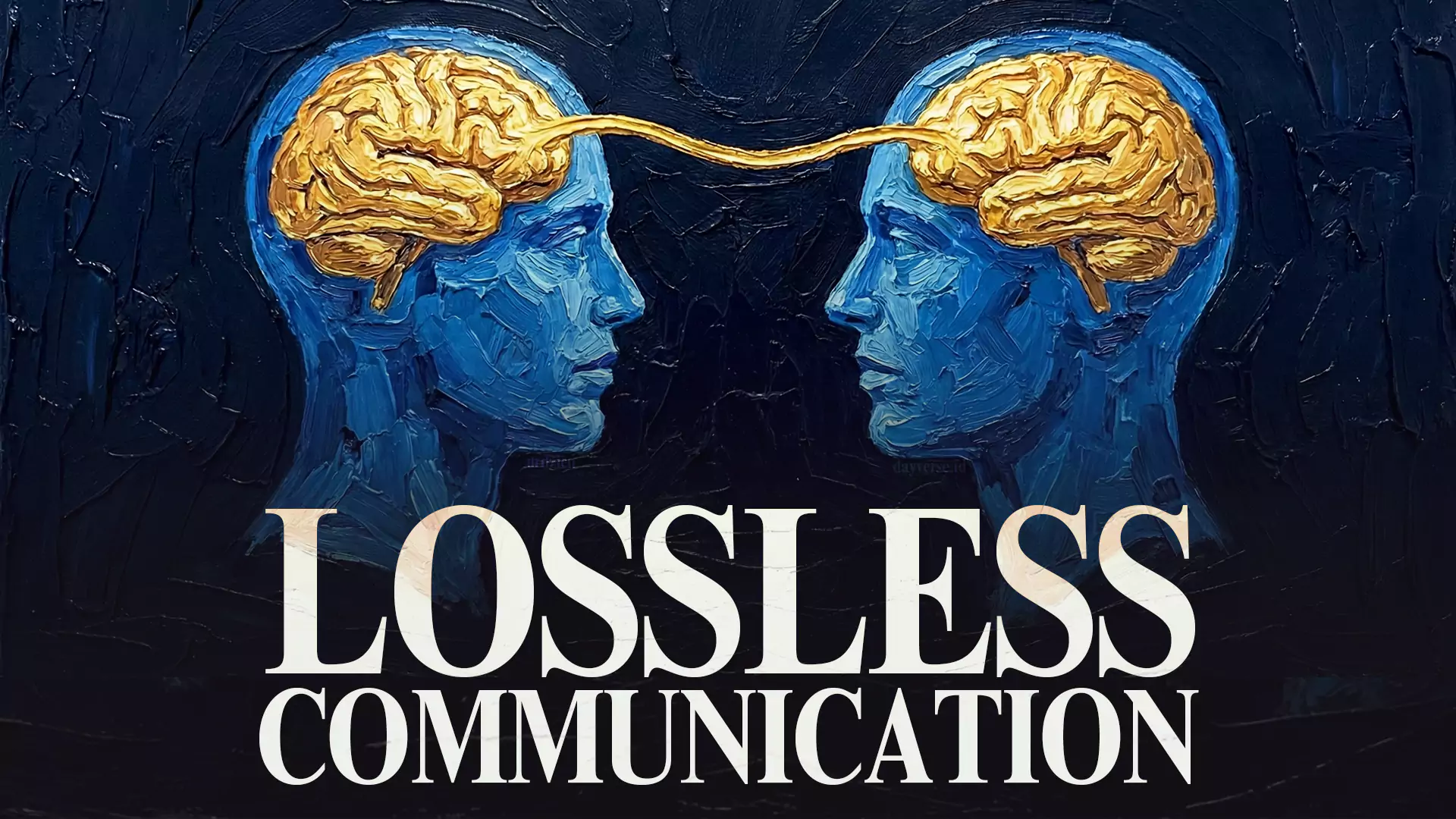
There is a fundamental misconception we often experience in everyday life that we frequently treat what others say about us as an absolute truth, when in reality it is merely information. The difference between the two is crucial to understand if we want to have a healthy understanding of our identity.
Others’ Statements Are Information, Not Truth
When someone says something about you, whether it’s praise or criticism, that statement is not an objective truth. Nor is it a mistake. What’s more accurate is to view it as information that contains two dimensions simultaneously. First, it’s information about you from their perspective. Second, it’s information about how they view the world.
Let’s take a concrete example. Imagine someone says to you, “You’re boring.” The wrong response is to immediately conclude, “I am indeed a boring person.” This is a problematic logical leap. What’s more accurate is to say, “According to this person, I’m boring.” The difference may sound trivial, but its implications are enormous.
In the first phrase, you are adopting someone else’s judgment as a universal fact about yourself. In the second phrase, you are recognizing that judgment as the perspective of one individual at a specific moment.
When Many People Say the Same Thing
You might be thinking, “But what if it’s not just one person? What if ten, twenty, or even a hundred people say the same thing about me?” This is a more complex situation, but the basic principle remains the same.
If many people say you’re boring, the correct conclusion is not “I am indeed boring as a universal fact,” but rather “Many people consider me boring.” This may sound like wordplay, but it’s actually a fundamental philosophical difference in how we build self-understanding.
The information that many people consider you boring is valid and potentially useful data. This data can tell you about how you’re received in certain social contexts, or perhaps indicate that there’s an aspect of your communication style that you need to reconsider. However, this data doesn’t automatically define your essence.
Self-Definition Remains Yours
The next question that arises is whether you are boring. The answer depends on you. If you think you are boring, then that is information from yourself about yourself. However, this remains just information and not an absolute truth carved in stone.
What’s interesting is that your definition of yourself is neither more right nor more wrong than others’ definitions. All these definitions coexist as different pieces of information. They do not cancel each other out, and there is no need to force them into alignment.
When Information Varies
Let’s take a more complex scenario to illustrate this point. Imagine you consider yourself not good at public speaking. However, a group of people who heard your presentation say you’re very charismatic and convincing. On the other hand, there’s another group that finds your presentation confusing and unstructured.
In this situation, you have three different sets of information. First, information from yourself that you’re not good at public speaking. Second, information from the first group saying you’re charismatic and convincing. Third, information from the second group saying you’re confusing and unstructured.
There’s no way to resolve this contradiction by seeking a single “truth.” You can’t impose your perspective on the first group who considers you charismatic, and you also can’t force the second group to change their views. All three perspectives are equally valid as information about how you’re perceived in different contexts and by different people.
Control Over Your Identity
Understanding the difference between information and truth gives us extraordinary freedom. We don’t need to be trapped in the exhausting effort to prove or refute every judgment others give us. We also don’t need to feel destroyed when someone criticizes us, or become arrogant when someone praises us.
Instead, we can adopt a wiser attitude by gathering information from various sources, including ourselves, and using it to make conscious decisions about how we want to grow. If many people say your communication style is harsh, that is useful information to consider. Do you want to change it? That is your decision. But that decision does not start from the premise that “I am indeed harsh and must change.” It starts from the understanding that “many people perceive me as harsh, and I want to consider whether this perception aligns with how I want to be received by certain social groups at certain times.”
Conclusion
Ultimately, what others say about you is information about how they see you, influenced by their background, values, experiences, and even their mood at that moment. This information can be useful, can be ignored, or can be used for reflection, depending on the context. What shouldn’t happen is treating this information as an absolute truth that defines who you really are.
Your identity is something that continuously evolves, shaped by a complex combination of how you see yourself, how others see you, and the conscious choices you make in responding to all that information. None of these components has a monopoly on the truth about who you are. They are all information that coexists, and wisdom lies in the ability to navigate this complexity without being trapped in a single perspective.