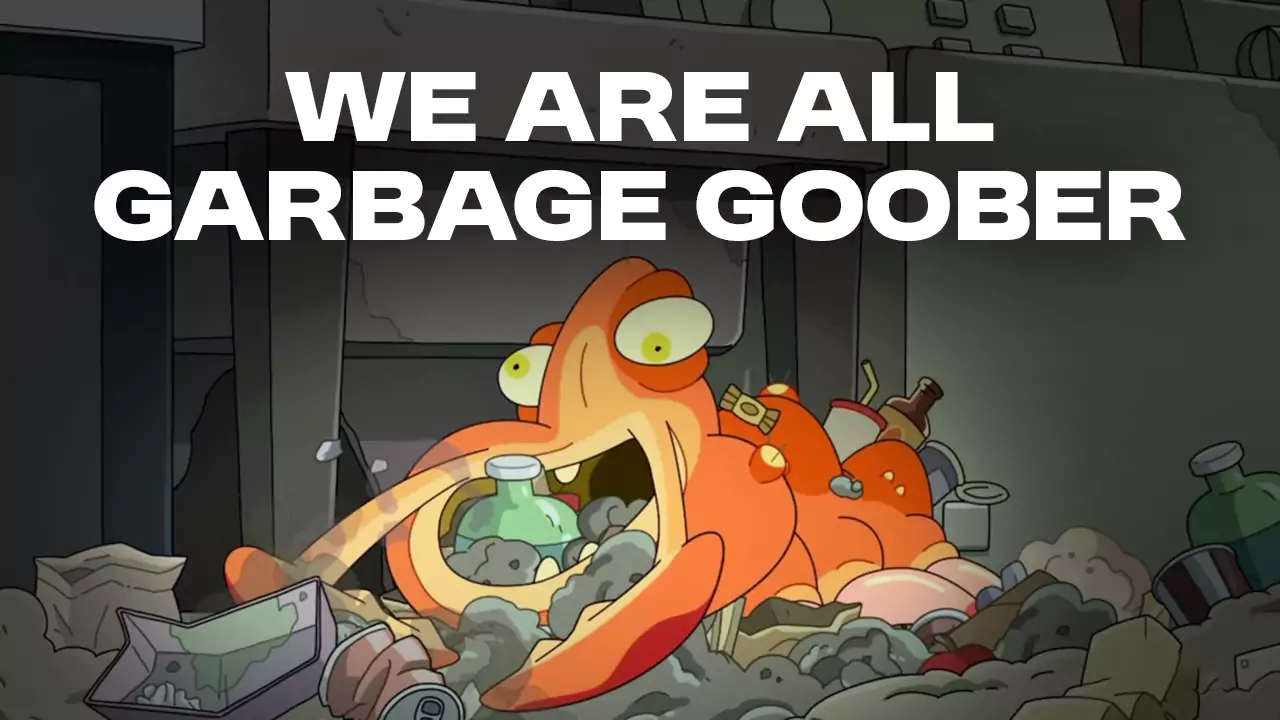
Amidst the signature absurdity of the animated series Rick and Morty, the character Garbage Goober—later revealed to be a man named Harold—emerges as an unexpectedly poignant metaphor for the contemporary human condition. A Harvard Medical School graduate who chooses to spend his life eating trash, Harold becomes a mirror that forces us to confront the friction between social expectations, personal fulfillment, and the construction of identity in the modern era.
What makes Harold so relevant isn’t the absurdity of his choice, but how he represents the existential dilemma we all face: Do we live to satisfy the expectations of others, or do we pursue what genuinely makes us feel alive—even if that pursuit is deemed “trash” by society?
The Paradox of Passion versus Prestige
One of the most striking themes in the Garbage Goober phenomenon is the tragic irony of his Harvard degree. Harold is the literal definition of the “do what you love” mantra—but with a disturbing twist. He possesses the highest credentials achievable within the capitalist education system, yet he chooses a role that sits at the absolute bottom of the social hierarchy.
This raises a fundamental philosophical question: What is the value of prestige if it fails to yield satisfaction? In our society, higher education is sold as the path to a “better” life—but “better” according to whose standards? Harold challenges this premise. He possesses all the symbolic capital society craves, yet he discards it for something more essential: personal happiness.
However, this happiness comes at a cost. His wife’s reaction illustrates that Harold’s choice isn’t just an individual one; it has social and relational consequences. This is the existential dilemma articulated by Jean-Paul Sartre: we are condemned to be free, but our freedom is always entangled with the gaze and expectations of others. Harold is “free” to choose the work he loves, but this freedom alienates him from his partner and his past.
Addiction or Authenticity?
Some perspectives view Harold as an allegory for addiction—someone who knows their behavior is destructive but cannot stop. The physical evidence supports this reading: Harold’s body is covered in boils and lesions from consuming waste, while his wife, who doesn’t share his diet, has clear skin. It is a visual manifestation of the consequences of his choices.
Yet, this is where the complexity lies. Is Harold truly an addict, or is the label of “addiction” simply society’s way of pathologizing an unconventional form of happiness? When Rick’s calling bell rings and Harold’s eyes light up, when he sings “Mmm trash, I love trash”—is this a symptom of a disease or a pure expression of passion?
This calls to mind Michel Foucault’s concept of “normalization,” where society establishes categories of “normal” and “abnormal.” Anything that deviates from the norm is treated as a pathology to be cured. Harold’s enjoyment of trash is “abnormal,” and thus must be categorized as a problem—be it addiction, failure, or self-loathing.
But what if the category itself is the problem? What if what we call “addiction” is sometimes just a form of pleasure that makes us uncomfortable because it challenges our assumptions about what should make someone happy?
A Toxic Relationship or a Toxic Society?
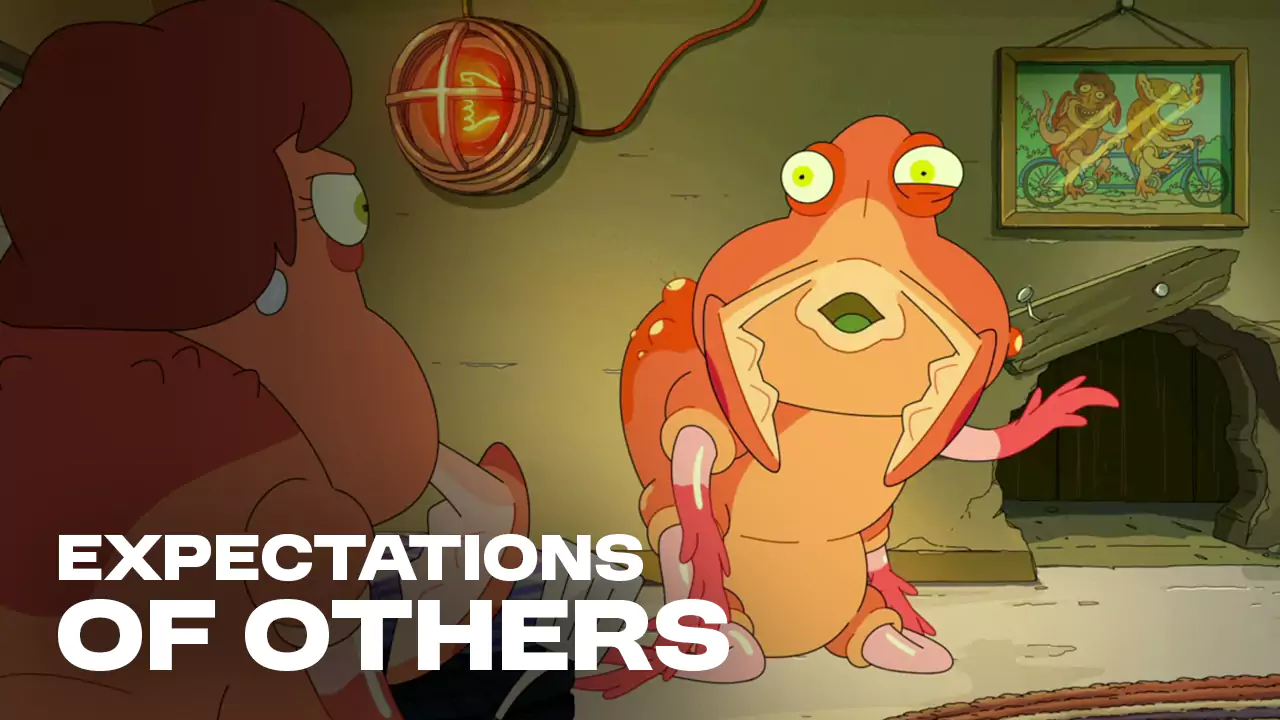
Harold’s primary struggle seems to be not with his job, but with a home life that offers no support. His wife does not work, yet she spends her time criticizing his choices. She makes no effort to understand what fulfills him, instead subjecting him to a constant barrage of expectations that run counter to his desires.
But is it fair to blame her entirely? Or is she also a victim of the same value system that punishes Harold? She lives in a world where a person’s worth is tied to their job title. Perhaps she feels a sense of reflected failure, unable to reconcile her husband being “just” a garbage eater with the social status a Harvard doctor “should” maintain.
This points to a broader structural question: how much of our interpersonal conflict is actually a manifestation of macro-societal pressures? When Harold’s wife screams, “You’re a doctor, for God’s sake!” she isn’t just speaking as an individual—she is acting as a megaphone for a society that dictates a hierarchy of labor, one that Harold has betrayed.
Rick as the Ultimate Capitalist
There is a dark irony in the fact that Rick Sanchez—one of the most manipulative and amoral characters in modern television—is the only one who “values” Harold. Rick pays him, Rick says “I love that little guy,” and Rick provides the validation that Harold’s wife cannot.
But is this real appreciation? Rick possesses technology far beyond human comprehension. It is entirely possible that Harold’s “love” for trash isn’t authentic at all—it could be the result of conditioning or direct mental manipulation.
This serves as a perfect metaphor for late-stage capitalism: we are given the “freedom” to choose, but our choices are pre-conditioned by the system. We are “free” to choose any job, but the available roles, the compensation, and even our own desires are shaped by structural forces larger than ourselves.
Rick pays Harold more than he could earn as a doctor—not out of kindness, but because Rick can. This highlights the absurdity of the “value of labor.” Value is determined not by skill, education, or even social utility, but by the arbitrary whims ofThose who hold the capital. Harold might have saved lives as a doctor, but Rick pays a premium for his personal entertainment.
We Are All Harold
Ultimately, Garbage Goober is a mirror. We might not literally eat trash, but how many of us consume metaphorical “trash” every day? How much of our time is spent on things we know aren’t good for us, yet we find ourselves unable to stop?
More importantly, how many of us live in the tension between what we want and what is expected of us? Between the identity we project and the feelings we actually harbor? Between the credentials we carry and the satisfaction we seek?
Harold is an extreme embodiment of our collective condition. He is what happens when you push modern contradictions to their logical, absurd conclusion. And in that absurdity, we find an uncomfortable truth: the difference between us and Harold might only be a matter of degree, not of kind.
We all have our own “trash.” The question isn’t whether we will stop eating it—the question is whether we can be honest about what we are consuming, and for whom we are consuming it.
Questions Without Answers
Garbage Goober offers no easy resolutions. Like all good philosophical inquiries, he only adds more weight to our shoulders.
Is a happiness that destroys the body better than a success that destroys the soul? Are we more authentic when we follow our passions, or when we fulfill our social responsibilities? At what point does pleasure become addiction? And who has the authority to decide?
Perhaps this is the final lesson of Harold. In an absurd world where social structures demand things that contradict individual desires—where identity is a performance and authenticity is often an illusion—the only form of resistance left may be choosing our own trash.
Maybe in the midst of that absurdity, when Harold sings “I love trash” with a genuine smile—even if it’s the result of manipulation, even if it’s destroying him—there is something more honest there than he ever would have found by being a doctor he never wanted to be.
And perhaps that’s the point.
“Mmm, trash. I love trash. Yum, yum, trash. I wanna eat trash.”
So says Garbage Goober, trash-eating existentialist and graduate of Harvard Medical School.