In everyday life, humans easily draw cause-and-effect conclusions. “I study, therefore I’m smart.” “I don’t shower, therefore I smell.” “She’s angry because I’m annoying.” Statements like these feel natural, intuitive, and practical. However, this ease conceals a profound epistemic problem. What actually happens when we are so confident in these simple explanations? Humans often treat single-cause narratives as representations of actual reality, rather than merely pragmatic tools for acting in a world full of uncertainty.
This article argues that the main problem is not the inference error itself, but rather the level of epistemic certainty that humans assign to causal inferences in a complex and non-isolated world. In other words, it’s not about drawing wrong conclusions, but about being too confident in the conclusions we draw.
Simplification as a Cognitive Necessity
Humans have real cognitive limitations. When facing a world filled with thousands of interacting variables every second, our brains rely on heuristics to survive—by simplifying, abstracting, and selecting the most prominent or easily recognizable factors. This simplification is not a mistake, but a survival strategy tested by evolution. Without this ability, decision-making would be paralyzed, and we would drown in an ocean of unlimited information.
However, when exactly does this useful simplification become a problem? The problem arises when this simplification quietly changes status—from a practical tool we use for daily navigation to an epistemic claim about how the world “actually works.” In other words, humans don’t simply say “this explanation is sufficient for now,” but act as if “this is the reason, period.” This subtle shift has major consequences for how we understand reality and interact with the world’s complexity.
Single-Cause Narratives and Veiled Claims about Reality
When someone says, “he failed because he’s lazy,” the statement appears simple and straightforward. However, behind that simplicity lies a series of epistemic decisions that are rarely recognized. Often, in statements like this, other factors that might play a role are simply ignored, such as socioeconomic context, deteriorating mental health, absence of structural opportunities, or even unfavorable luck. Alternative explanations that might be equally valid are rejected without serious consideration, and attempts to correct or expand the narrative are even considered contrived or overly complicated.
This shows that single-cause narratives are not always treated as pragmatic summaries whose limitations we acknowledge, but as complete ontological explanations, as if one cause is sufficient to explain the entire event that occurred. But how can such a complex world be explained by a single cause? After all, causal systems in real life have very different characteristics, where these systems are never isolated from external influences, occur simultaneously with other processes, are non-linear so that small causes can produce large effects or vice versa, and mutually influence each other in complex causal networks.
The Non-Isolated World and the Problem of Certainty
In well-controlled scientific experiments, researchers can isolate certain variables and control the environment so that cause-and-effect relationships can be observed relatively clearly. Laboratories are specifically designed to create ideal conditions where only one or a few factors are allowed to change, while others are kept constant. However, human life is never, and will never be, in such laboratory conditions.
Therefore, the causal inferences we make in everyday life are almost always probabilistic, not deterministic. This means that what we can honestly say is “factor X most likely contributes to outcome Y,” not “X definitely causes Y.” So why do we so often speak as if we definitely know the cause? The problem is not that such inferences are fundamentally wrong, but that humans often assign a level of certainty disproportionate to the available evidence. We act as if the causal relationships we observe are stable and universal, applicable in all contexts and times, and we reject or feel uncomfortable with the uncertainty inherent in complex and ever-changing reality.
This is a form of systematic epistemic overconfidence, not merely a formal logical error that can be corrected with more careful reasoning. This is a deep cognitive tendency to desire certainty in a world that is fundamentally uncertain.
“It Works” Is Not the Same as “It’s Correct”
Often, when criticism of causal simplification is raised, the defense that emerges is to say “What matters is that it works, right?” or “If it’s not accurate, why is it useful?” However, it must be understood that “working” in a practical context is not epistemically neutral. The concept of “working” presupposes successful prediction and action in a certain limited context, not comprehensive truth about how reality actually operates.
An explanatory model can be locally useful in certain situations and times, can succeed temporarily because the conditions supporting it happen to be stable, yet still not represent reality completely or accurately in the long term. Maps are a good example in this regard, because maps are very useful for navigation, but no map truly captures all the details of the mapped territory. “The map is not the territory,” said Alfred Korzybski. Maps work because of their specific purpose, not because they are identical to reality.
The problem arises when pragmatic success is misinterpreted as a guarantee of ontological truth. When we say “this works, therefore this is true,” the question is: aren’t we making a dangerous logical leap? We jump from utility to truth, from what is useful to what actually happens, without realizing that these are different things.
Rejecting Excessive Certainty
It’s important to emphasize that this article does not argue that humans should not draw conclusions from experience, or that causality does not exist as a valid concept, or that science and empirical methods have no value. That would be a fundamental misunderstanding of the argument being made.
What is being criticized here is the widespread human tendency to ignore background conditions that are invisible yet influential, underestimate the simultaneity of causes where many factors work together at the same time, and treat the rough explanations we use daily as full truths that need not be questioned anymore. This criticism is not a call for paralyzing radical skepticism, but for what could be called “productive uncertainty”—an awareness of the limitations of our knowledge that actually makes us more careful, more open to new information, and more humble in the claims we make.
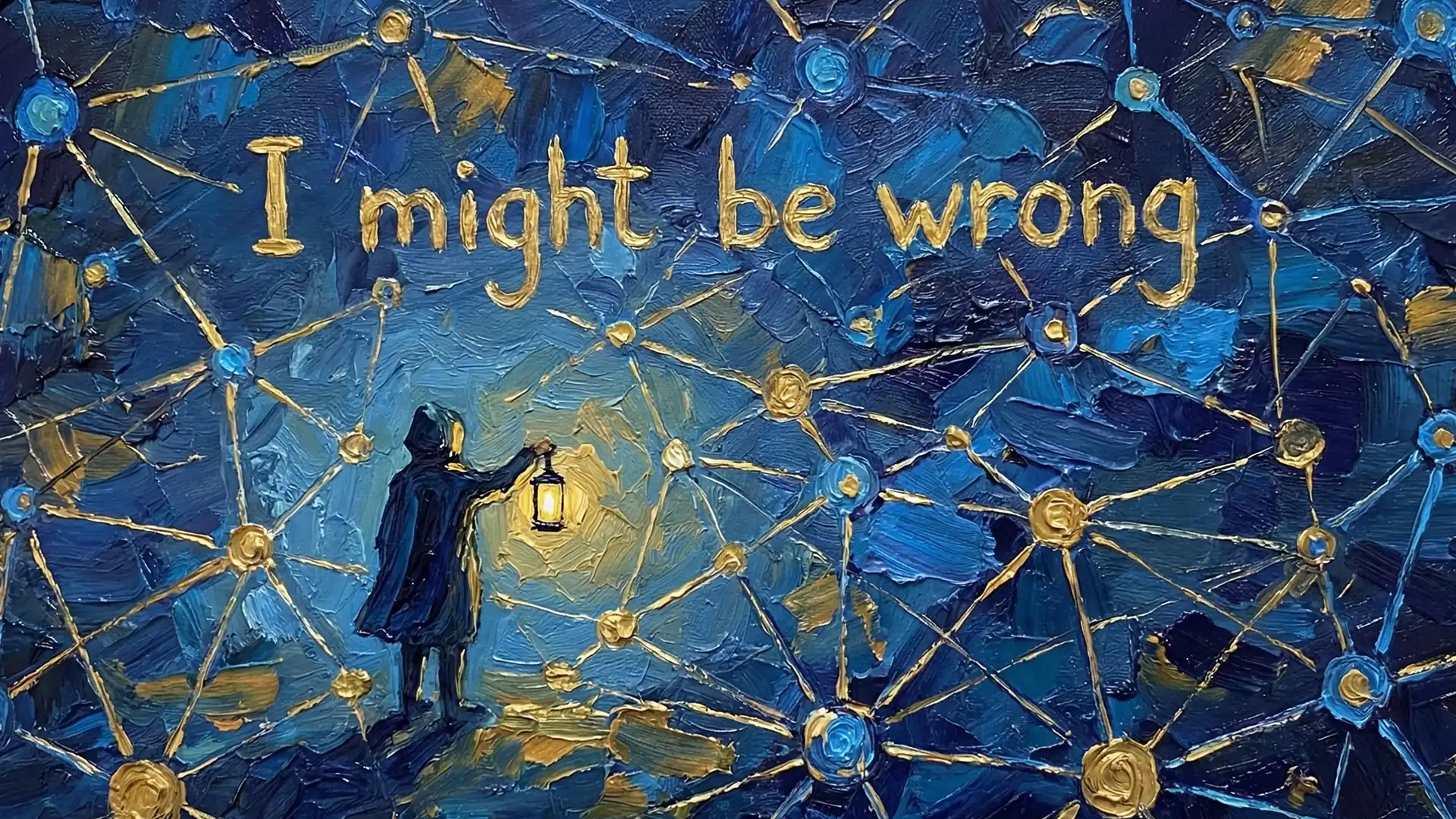
In a non-isolated world, where everything is connected in ways we often don’t fully understand, a more honest and wiser epistemic attitude is not the rejection of inference, but humility toward complexity. What if the ability to say “I think this is the cause, but I could be wrong” is actually a sign of mature thinking? This is not intellectual weakness, but strength that demonstrates mature thinking, not hesitant thinking.
Conclusion
Single-cause narratives are useful, even inevitable cognitive tools given the limited capacity of the human brain’s information processing. We need them to act quickly, to make decisions in limited time, to communicate efficiently. There is nothing wrong with using this tool in the right context.
However, when that tool is equated with reality itself, when simplification is treated as a complete explanation, when the model is considered the same as what is being modeled, humans risk understanding the world too simply and acting with certainty that is not commensurate with the complexity that actually exists. This misunderstanding has real consequences, as we make bad decisions because we don’t consider important factors, we unfairly blame others because of overly simple causal narratives, we reject evidence that conflicts with our mental models.
Awareness of these limitations, ironically, does not weaken human rationality, but actually strengthens it. By acknowledging that our knowledge is always partial, that our inferences are always probabilistic, and that complete certainty is almost never achieved in the domain of real life, we actually become more rational, in the sense of being more open to correction, more capable of learning from mistakes, and wiser in our actions. Epistemic humility is not the enemy of knowledge, but the foundation of wisdom.